
Opening : 8 am - 11 pm
January 14th
2024
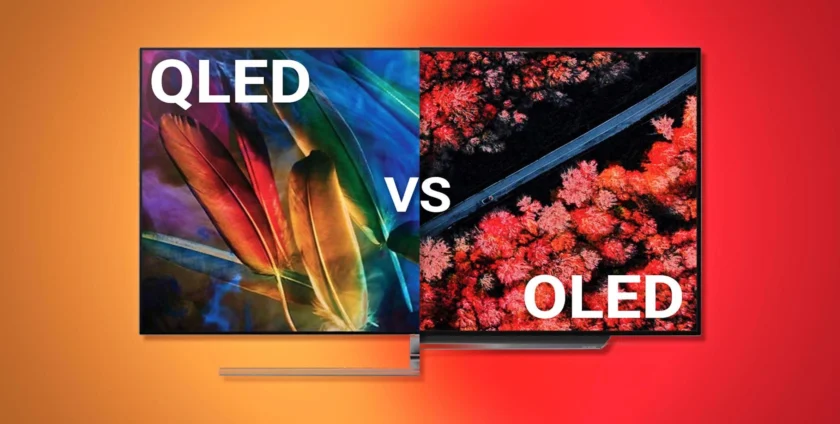
TVs have become more than just platforms through which we get information and stay entertained. Granted, they haven’t lost their fundamental functionality. However, over the last couple of years, with the technological developments that have deluged the infotainment sectors, and TVs in particular, they have become a staple for the modern home. When choosing a new TV, the debate often centers around OLED vs QLED technology.
That being said, with the different types of TVs on the market today, it may turn out to be a difficult task to find the one that works best for you. As a result, you need to be knowledgeable about the different televisions available to make an informed decision. This article aims to do so, by pitting two of the more prominent TV types right now, OLED vs QLED.
How They Function
The fundamental difference between the two types is the means they use to display images. OLED is an acronym for Organic light-emitting diodes. From the name, it is easy to understand that the said TV uses light-emitting diodes to display the images. The diodes, which are tiny pixels, expose the image by emitting different colors of light. There are millions of them, and they work in tandem to this end.
QLED, on the other hand, stands for Quantum Dot Light-emitting diode. Unlike OLED TVs, the Quantum Dots present in QLED televisions do not emit their oven light. An LED back light provides the light that hits the quantum dots, which they, in turn, create their fluorescence, thus generating the colors required for the picture.
Having understood the means through which they create their light, it becomes relatively easier to establish the upsides and downsides of each type.
The Upside of OLED TVs
One of the biggest upsides of having an OLED is the contrast the TV has. Its black level is second to none. Consequently, because of its ability to proliferate the dark colors, the bright colors are also accentuated. Simply put, the darker the screen, the higher the level of contrast. The science behind this simple phenomenon is the ability of the TV to completely shut off the diodes, thus creating the pitch black color.
The Upside of QLED TVs
Even though OLED TVs are darker and have a higher level of contrast, QLED TVs offer brighter colors and thus more detailed images. As a result, this type is ideal for brightly lit rooms, or if you have an eye for details.
Affordability and availability are other major selling points for QLED TVs. The smallest OLED TV in the market at the moment is 55 inches. That may pose a problem, not only in terms of space but also when it comes to the amount of money you have to pay. QLED TVs, however, come in a wide array of sizes, ranging from 43 inch ones to 85 inch ones. The 98″ 8K smart QLED TV by Samsung is the largest.
The potential for improvement for QLED TVs is immense. As more technology is integrated into the TV, the sky is the limit for this one.
The Downside of OLED TVs
OLED TVs offer exceptional image quality, but they do have some downsides. One of the main drawbacks is the potential for burn-in, where static images, such as logos or news tickers, can leave permanent ghosting marks on the screen. OLEDs are also more susceptible to degradation over time, meaning the screen’s brightness may decrease as the panel ages.
The Downside of QLED TVs
Despite their impressive display quality, QLED TVs have some downsides. One drawback is that their black levels may not be as deep as those of OLED panels, leading to less contrast in dark scenes. This is because QLEDs use a backlight, while OLEDs are self-illuminating. Another downside is the potential for colour degradation over time, especially when viewed at extreme angles.
Brightness vs. Contrast
Durability
Price Point
Your Decision
As you may have noticed, OLED vs QLED TVs have its upsides and its downsides. It is up to you to weigh them and choose one based on your preferences. All of them have something special to offer to you and your home, and so the choice is solely based on what you prefer.
For a free consultation service and quote, call us on 1300 761 800


Leave a Reply